
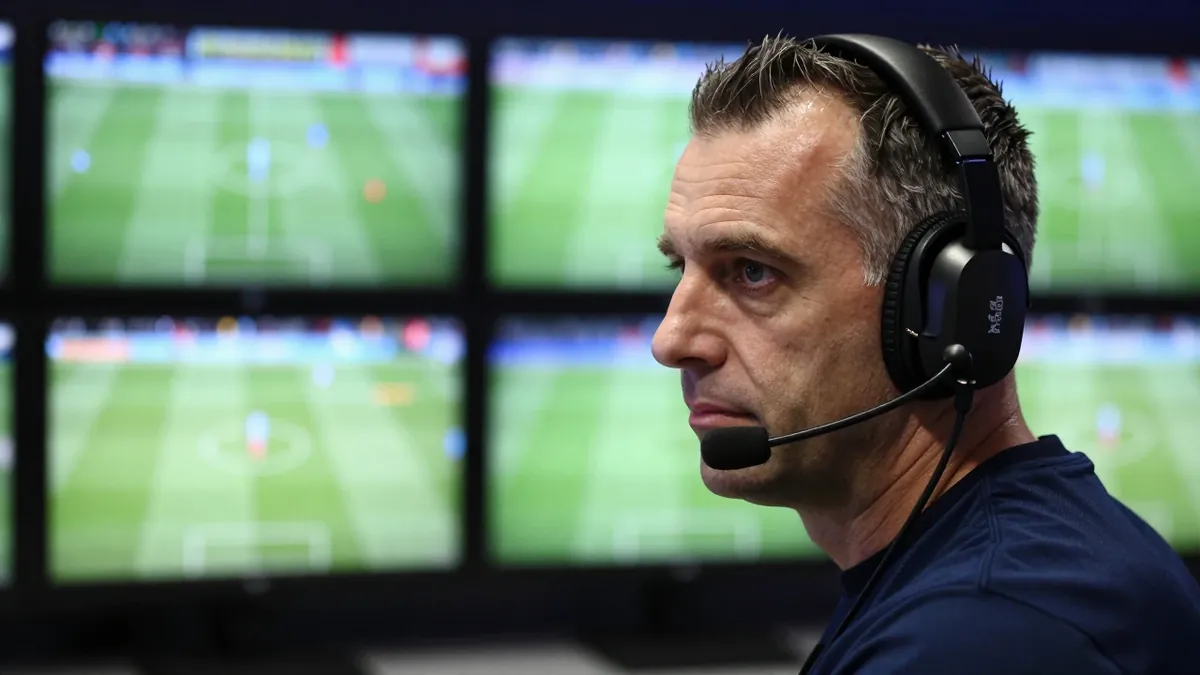
The Chinese Football Association has issued an official statement addressing the controversy over VAR offside lines in the Shanghai Shenhua versus Shandong Taishan match, firmly refuting claims made by self-media accounts. According to Dongqiudi, the CFA Referee Committee determined that the on-site VAR operation fully complied with established procedures and technical standards.
What sparked the VAR controversy
The dispute originated from the Chinese Super League match between Shanghai Shenhua and Shandong Taishan on September 1st. Following the game, several self-media accounts posted video analyses questioning whether the VAR offside line-drawing process followed proper protocol. These videos spread rapidly across social media, sparking discussions among fans about refereeing fairness and VAR technology reliability. The CFA initiated an internal review after noticing the online discourse.
After detailed examination, the CFA Referee Committee stated: "经中国足协裁判委员会复核审定,现场VAR操作符合工作流程和技术标准,认为相关自媒体作者不了解越位划线的工作程序和技术标准,视频分析不符合事实,误导了公众。" This official response directly addresses the external doubts and upholds the authority of the match decisions.
How the VAR system ensures accuracy
The CFA's statement elaborates on the VAR system's operational mechanisms. When a potentially offside goal occurs during a match, the on-field referee makes an initial call, after which VAR conducts a comprehensive review. This review process includes the complete line-drawing procedure, with all results promptly communicated to the main referee. In the Shenhua-Taishan match, VAR strictly followed standard protocols, with no post-decision line drawing or editing taking place.
The VAR system used in the Chinese Super League is supplied by a FIFA-certified international provider. Before each match, technicians calibrate the pitch and create a 3D model to ensure line-drawing precision. Football pitches are not completely flat, typically featuring drainage arches, and different camera angles create optical distortion. The VAR system compensates for these factors through multi-angle calibration and 3D modeling, automatically generating offside lines that operators cannot manually alter.
After review completion, VAR sends results and relevant video clips to broadcast partners. Broadcasters decide when to display these visuals during live coverage based on match flow. VAR can only select key frames at the moment of pass or touch, generating offside lines based on players' effective body parts and their projection positions. The system design minimizes potential human intervention.
How this controversy affects Shenhua
For Shanghai Shenhua, this technical dispute comes during a key period as the team competes for a top position in the league standings. Shenhua currently sits near the top of the CSL table, where every match result could impact final positioning. The team has shown consistent form recently, remaining unbeaten in their last five matches with three wins and two draws.
Shenhua's defensive organization has been particularly impressive this season, conceding only 15 goals so far, making them one of the league's tightest defenses. This stability proves vital against strong opponents like Shandong Taishan. The attacking unit maintains efficiency, averaging over 12 shooting opportunities per game. Fans can check more detailed team statistics on our stats page.
The manager's tactical setups have yielded positive results in recent matches, with improvements in possession rates and passing accuracy. Shenhua faces a series of important fixtures ahead, including direct clashes with several title contenders. The complete schedule is available on our fixtures page.
What's next for VAR technology in the CSL
This controversy highlights the importance of VAR technology transparency. While the system itself maintains high accuracy, clearly demonstrating decision rationale to viewers remains an area for improvement. FIFA has promoted VAR standardization in recent years, and the CFA has committed to refining related procedures.
The CSL may eventually adopt more advanced semi-automated offside technology, which uses multiple dedicated cameras to track player positions and generate offside decisions almost instantly. This system already sees application in top European leagues and World Cup matches. Technological upgrades require corresponding hardware investment and personnel training, which the CFA is currently evaluating.
For refereeing teams, clearly communicating decision rationale remains equally important. Even with VAR assistance, final decisions rest with on-field officials. Enhancing referees' ability to explain calls helps reduce fan misunderstanding and controversy. The CFA plans to strengthen referees' media communication training to make technical decisions more transparent and understandable.
The Shanghai Shenhua squad currently focuses on preparing for their next league match, an away fixture against the third-placed team in mid-September. Players aim to respond to off-field controversies with on-pitch performances as they continue pursuing seasonal objectives. Complete squad information is available on our squad page.